
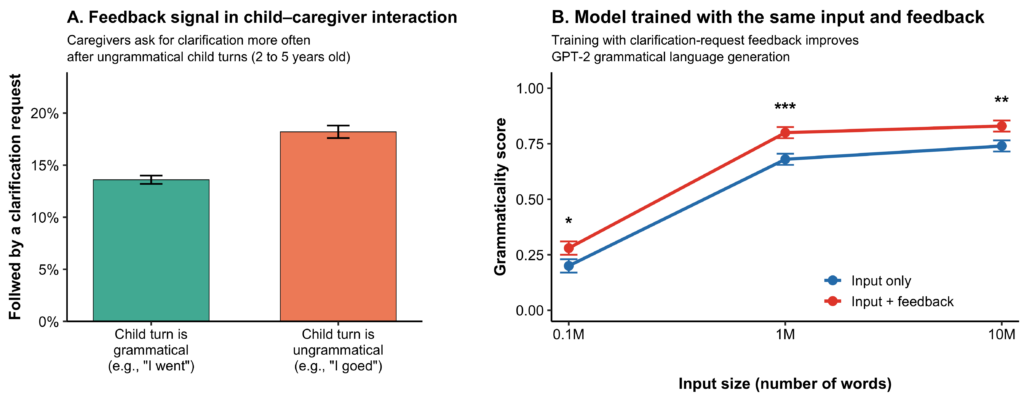
In natural child–caregiver conversations, caregivers are more likely to ask for clarification after a child says something ungrammatical, such as “I goed,” than after a grammatical utterance, such as “I went”, shown in Panel A. This means that clarification requests carry information about whether the child’s sentence was well formed. In real conversations, input and feedback to children are tightly correlated, so it is hard to know whether feedback itself adds anything beyond the language children already hear.
We leveraged computational modelling (GPT-2) to test whether clarification requests can actually help learning. By training GPT-2 on the same linguistic input that children hear, either with or without the clarification-request feedback they receive in conversation, we isolated the specific contribution of feedback to grammatical learning. Panel B shows that the model trained with feedback develops better grammatical language, suggesting that everyday conversational responses in children’s experience can provide a useful learning signal.
Philosophical Transactions B 381 (1943): 20240374 — @HAL