


FEATURED PUBLICATIONS
Speaking to a common tune: Betweenspeaker convergence in voice fundamental frequency in a joint speech production task Vincent Aubanel, Noël Nguyen
2020 PLOS/ONE
read more >>
Learning to Read and Dyslexia: From Theory to Intervention Through Personalized Computational Models Johannes C. Ziegler, Conrad Perry, Marco Zorzi
2020 Current Directions in Psychological Science
read more >>
Error-based learning and lexical competition in word production: Evidence from multilingual naming Elin Runnqvist, Kristof Strijkers, Albert Costa
2019 PLOS/ONE
read more >>
Constraints on the lexicons of human languages have cognitive roots present in baboons (Papio papio) Emmanuel Chemla, Isabelle Dautriche, Brian Buccola, and Joël Fagot.
2019 PNAS
read more >>
High-fidelity copying is not necessarily the key to cumulative cultural evolution: a study in monkeys and children Carmen Saldana, Joël Fagot, Simon Kirby, Kenny Smith, Nicolas Claidière
2019 Proceedings of the royal society B
read more >>
Bringing together experts in linguistics, neuroscience, psychology, medicine and computer science to understand and to model the way that language functions.
The objective is to create a generic model of the processing of language and its cerebral bases.

SUMMER SCHOOL
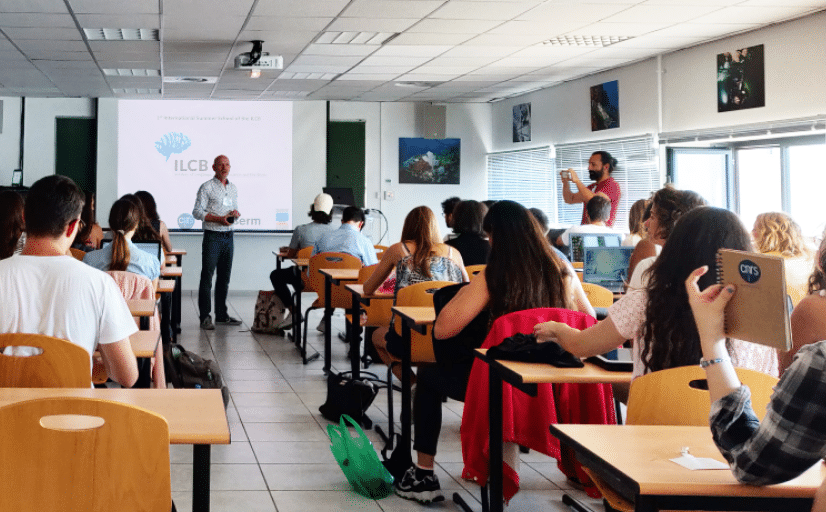
The 3d Edition of the ILCB Summer School offers Introductory, Intermerdiate and Advanced Classes in four core fields of Cognitive Science, reflecting the expertise of the Institute.
read more >>
PhD PROGRAM
An interdisciplinary focus on language research, with interdisciplinary theory and practice trainings at basic and advanced level courses in all relevant disciplines.
read more >>
MASTER
The MaSCo, a new MA in Cognitive Science, provides an advanced scientific curriculum on human cognition, as well as a technological and methodological expertise in evaluation, analysis and modeling of cognitive processes.
read more >>
TRAINING
Advanced trainings are offered to the ILCB members
read more >>
Retrouver la chaîne de l’ILCB

Recent
news and events
Upcoming Events Loop
It seems we can’t find what you’re looking for. Perhaps searching can help.
Post Loop
Jakob Scherm Eikner
Jakob Scherm Eikner is starting a PhD this month at the Laboratoire Parole et Langage (LPL). Jakob holds a Master’s degree in Linguistics from the University of Oslo. Jakob works with Elin Runnqvist (LPL) and Clément François (LPL), in collaboration with Kristof Strijkers (LPL), studying self-monitoring mechanisms in speech production and other human actions. The […]
Greta Gorzoni
Greta Gorzoni is starting a PhD at the Laboratoire Parole et Langage (LPL) this month, supervised by Laurent Prévot and Francesca Di Garbo. Greta holds a Master’s degree in Linguistic Sciences from the University of Bologna, where she specialized in linguistic theory and computational methods. Her PhD project investigates linguistic abstraction and generalization, focusing on how linguistic patterns […]
Advanced Theory of Mind Abilities in Adolescents
Many studies have examined theory of mind (ToM) abilities in adolescence, but none appears to have tested them in real interactive settings. To address this gap, we assessed advanced ToM abilities using a referential communication task in which pairs of participants had to order unfamiliar and abstract figures without seeing each other. The ratio of […]
Mia Steffen
Mia Steffen began her PhD in cognitive science at Laboratoire Parole et Langage (LPL) in September 2026. Mia holds a Bachelor’s degree in Psychology from Université Lumière Lyon 2 and a Master’s degree in Cognitive Science from Aix-Marseille University. Her doctoral research is part of the ERC-funded Language in the Dyad (LaDy) project under the […]
Exploring Addressee Styles in Spontaneous Conversations
Auriane Boudin, Stéphane Rauzy, Roxane Bertrand, Philippe Blache, Matthis Houlès, Magalie Ochs, and Louis-Philippe Morency 2026. Journal of Pragmatics 263 : 24–49.
Dopamine Modulation of Motor and Implicit Learning Contributions to Auditory Temporal Attention
Arnaud Zalta, Lena-Franziska Spitz, Alfons Schnitzler, Benjamin Morillon, and Esther Florin. 2026. iScience 29 (10): 117541. — @HAL
Learning Regularities in Noise Engages Both Neural Predictive Activity and Representational Changes
Coumarane Tirou, Oussama Abdoun, Teodóra Vékony, Laure Tosatto, Andrea Brovelli, Marine Vernet, Dezső Németh, and Romain Quentin 2026. Nature Communications 17 (1): 8372. — @HAL
The Role of High-Amplitude Bursts of High-Gamma Activity in Naturalistic Speech and Music Listening
Matteo Neri, Claudio Runfola, Pierre Guilleminot, Noemie Te Rietmolen, Pierpaolo Sorrentino, Daniele Schon, Benjamin Morillon, and Giovanni Rabuffo 2026. Imaging Neuroscience 4 : IMAG.a.1348. — @HAL
“Investigating Multi-Level Discourse Coherence Patterns: Machine Learning vs. Deep Learning Modeling
Lilia Azrou, Houda Oufaida, Philippe Blache, and Israa Hamdine 2026. SN Computer Science 7 (7): 724. — @HAL
Scaffolding Early Dialogue: A Unified Account of Response Contingency in Child–Caregiver Interaction
Abhishek Agrawal, Benoît Favre, and Abdellah Fourtassi. 2026. Cognitive Science 50 (7): e70245. — @HAL